






2008 Quality Management Survey
| About this report… |
|
Materials Management in Health Care assembled this report from a survey conducted in cooperation with the Association for Healthcare Resource & Materials Management of the American Hospital Association and extensive interviews with hospital leaders and experts in quality management and the supply chain. We surveyed a sample of 4,673 hospital executives to learn about the prevalence of quality management programs in the hospital supply chain. The survey response rate was 15.2 percent or 710 completed surveys. Data by Suzanna Hoppszallern |
Materials Management in Health Care thanks the sponsors of this survey.
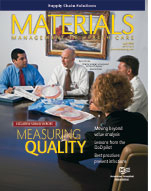 Even before the first statistical evidence rolled in, Roland Plude sensed that the new lean management program at his hospital was working.
All he had to do was look at all the doctors hanging around the materials management department to discuss projects or make small talk.
“A co-worker said that in the past we never had physicians come down to the materials management offices to engage in conversations,” says Plude, director of materials management for the past year at Baptist St. Anthony’s (BSA) Health System in Amarillo, Texas. “Now the doctors come by our offices all the time just to say hi and see what we’re working on. We’ve had a huge paradigm shift in how the physicians treat us.”
BSA, which built its program around establishing “clinical champions” for its products and services, is one of a growing number of U.S. hospitals implementing quality management initiatives in the supply chain to improve safety and efficiency while reducing costs.
Materials Management in Health Care and the Association for Healthcare Resource & Materials Management (AHRMM) conducted a nationwide electronic survey in November to gauge the prevalence of such programs and the extent to which external benchmarks are used to set performance targets. While health care still hasn’t embraced quality management techniques to the extent of the automotive, airline and other industries, the results confirmed growing use and widespread support for their value.
“We are seeing an increasing number of health care organizations using lean in the supply chain,” says Stephen Mayfield, senior vice president for quality and performance improvement for the American Hospital Association and director of the AHA Quality Center. Six Sigma also is proving its capabilities with more hospital systems, he notes, along with plan-do-check-act (PDCA), rapid cycle improvement and others.
Mixed progress
The survey, conducted by Perception Solutions Inc., found good intentions and broad interest, but a lack of follow-through by many of the 710 organizations that responded when it comes to pursuing quality management initiatives.
Momentum is indisputable. Forty-five percent of all lean management programs, 35 percent of Six Sigma programs and 33 percent of rapid cycle improvement programs established in materials management departments were initiated within the year before the survey was taken (see Fig. 4). But the pace of implementation remains gradual, even cautious.
Fifty-eight percent of those polled say their hospitals have implemented a defined quality management program in the supply chain (see Fig. 1). Yet when asked to pinpoint the particular area involved, the department-by-department figures were all low, ranging from 17 percent for surgical supplies and 20 percent for central service/sterile processing to a high of just 26 percent for materials management (see Fig. 3). The survey results carry a margin of error of plus or minus 5 percent.
| Fig. 1 Hospital has implemented a defined quality management program in the supply chain/materials management area | |
| Yes | 58% |
| No | 42% |
| Fig. 2. Primary driver to adopt a quality management program | |
| Administration (CEO, CFO, COO) | 67% |
| Nursing | 11% |
| Other | 10% |
| Materials management | 7% |
| OR manager | 3% |
| Central service | 3% |
| Physicians | 1% |
| Fig. 3 Hospital employs a defined quality management program in: | |
| Materials management | 26% |
| OR management | 25% |
| Emergency department | 22% |
| Central service/sterile processing | 20% |
| Surgical supplies | 17% |
| Fig. 4 Quality management programs initiated within materials management department and how long they have been in place | |||
| One year or less | 2 to 5 years | 6 years or more | |
| Six Sigma | 35% | 63% | 2% |
| Lean Management | 445% | 49% | 6% |
| PDCA | 11% | 41% | 48% |
| Rapid Cycle Improvement | 33% | 46% | 21% |
Source: Materials Management in Health Care/AHRMM 2007 Quality Management in the Hospital Supply Chain survey
Program barriers
Among those who said their hospitals had no quality management program whatsoever for the supply chain, barriers cited were a lack of resources, time, commitment and administrative support. One called it “another management fad.”
John Carrico, director of supply chain operations at the University of Minnesota Medical Center (UMMC) at Fairview, was surprised to see that close to half of the hospitals surveyed had not determined defined performance targets in several supply-chain departments. Regardless of how difficult benchmarking can be to establish, he says, it is essential. “Having something in place that looks at performance improvement-type plans and benchmarking is crucial to be competitive and reduce costs. If you’re not actively managing and using tools to implement that plan, I don’t think you’ll survive.”
Most respondents selected supply expense (74 percent) and cost savings (73 percent) as the metrics they use to measure process efficiency and improvement (see Fig. 9). Yet consultant Karen Young, who conducts workshops for hospitals on lean Six Sigma, maintains that cost isn’t the best indicator of process efficiency. Rather, she says, health care organizations should focus less on the physical aspects of the supply chain and more on eliminating waste and measuring and analyzing variations in their supply chain processes. Bad processes are inefficient and can triple or even quadruple the cost of supplies, Young says.
Look-and-see
The emerging wave of interest in quality management programs in the supply chain needs to get much bigger, she says. “We’re still not seeing enough hospitals taking a structured approach to addressing quality issues,” says Young, president and CEO of Strategic Solutions and Associates in Stone Mountain, Ga. “They’re still in the look-and-see stage. Some hospitals are looking at it from a high-level strategic viewpoint, but we’re not seeing that much in the supply chain departments.”
Plude likes what he sees so far from BSA’s program, launched in March 2007 as a formalized process to work with physicians. When he was a materials manager at Kansas City, Mo.-based Saint Luke’s Hospital, a past winner of the Malcolm Baldrige award for quality management, he learned the value of getting clinicians to buy into a process or item. After arriving at BSA, he helped institute processes in which materials management seeks physicians’ input on products while also involving nursing in evaluating its services.
The strategy is simple but effective. The BSA materials management team ap-proaches physicians and asks if they will provide feedback on certain gloves, gowns or other products. They then consult with clinicians to devise a list of five to seven questions for a product evaluation form, elicit their product input and tabulate the results. Finally, a board of doctors and other clinical experts evaluates the department’s cost analysis from a product trial and determines whether to implement the product. Not every product switch saves money, but already by last May, the department confirmed a total annual supply savings of $318,606, with other cost impacts yet to be determined.
Plude says the department has been successful with every product conversion brought forward to physicians, thanks to a staff who embraced the need to be more inclusive with clinicians. “Once you start the process it becomes very easy,” he says. “That’s not to say it’s not a lot of hours, a lot of time spent with physicians. You have to not be afraid to set lunch engagements in their offices or see them in their offices in the evenings.”
Beneficial results
Survey participants identified many changes that occurred as a result of their hospitals’ defined quality management initiatives. For example, 55 percent of respondents with such programs say they reduced waste or cost, 49 percent improved patient satisfaction, 48 percent improved outcomes, 44 percent reduced hospital-associated infections, 45 percent increased communication and 43 percent improved staff satisfaction (see Fig. 6).
The materials management department at La Crosse, Wis.-based Gunderson Lutheran Health System had only manual processes in place for reprocessing surgical instruments until five years ago. As a result, it was routinely missing instruments or sending the wrong trays to the operating room, with only an 84 percent accuracy rate. That figure improved to more than 90 percent with the purchase of a surgical instrument management system for less than $100,000 in October 2003. But the organization realized that other improvements were still needed.
When the organization decided to pursue lean management, Rod Brueggeman, central service manager, worked on a team that found—after many hours spent in operating rooms and from data gathered by the software program—that 64 steps were involved in the instrument sterilization process.
Looking for waste and nonvalue-added steps, they reduced it to 27, saving both time and labor. Within a year the accuracy rate had risen to 99.7 percent, and hospital officials say it has not been below 99.9 percent in more than a year.
Gunderson added a full-time equivalent position with the creation of a liaison between OR and central service to oversee the process and watch for exceptions. But Brueggeman notes that the dramatically increased accuracy enabled volume to be boosted by 6 percent to 8 percent, with no additional expense. Materials management then used lean management to redesign how the laundry department supplies linen to customers, with similar gains in productivity and costs. “No question there’s a bottom-line savings,” Brueggeman says.
Jan Jarvinen, Gunderson’s director of materials management, says the downside to lean is that it requires an intensive investment and labor effort up front, Jarvinen says. “But the upside is that your process is so much better and you’ve saved in so many ways—productivity, quality, efficiency and cost. It’s well worth the investment.”
Wellmont Health System in Kingsport, Tenn., incorporates numerous quality management strategies—including Toyota’s Production System Six Sigma, lean manufacturing and Baldrige models—in its supply chain. The organization pioneered the Safest Hospital Alliance, a consortium with the Adventist Health System and Novant Health, encompassing 50 facilities, that focuses on defining best practices and identifying standards for hospital safety.
The goal of the 1-year-old consortium is to combat the high number of medical errors by developing a comprehensive approach to patient safety. But one byproduct is a much more efficient supply chain, where the goal is to ensure physicians always have the right tools at the right time.
Allen Archer, Wellmont’s system manager for capital planning and acquisition, says that hinges in part on getting input from nurses via value analysis teams that look at the system’s needs and products’ effectiveness, value and cost. Physician-led new technology review teams also are used, which allow doctors to guide clinical practices within their facilities. Working together, the two teams have ensured a focus on standardization and cost reduction while keeping abreast of the latest technology. “If we have five different hospitals using five different products in five different ways, we bring the nurses to the table and they tell us the best way,” he says. “Nurses bring experience to the supply chain and allow us to see the clinical impact of what we do.”
The supply chain department also has set up equipment teams that bring items to the bedside, making sure nurses have IV pumps, suction regulators and other equipment ready rather than spending time running to the supply room and back. Archer says that due to a low unit of measure, the organization now keeps only three to five days’ supplies on hand; total inventory at its flagship facility has been reduced to $600,000 from $1.8 million. In the past, he says, hospitals wasted a lot of money and time because they didn’t see the big picture. A physician or administrator, for example, would come in with a list of capital items to buy, sometimes without knowing if a product had a questionable track record, didn’t fit with its information technology infrastructure or was for a procedure no longer being reimbursed. With lean, he says, “We’re able to see the big picture now.”
A defined quality management system has proven itself over the longer haul at the Central Metro Care System, which includes UMMC and the University of Minnesota Children’s Hospital, Fairviews. Carrico says UMMC spent about three years applying lean concepts to all its patient care units.
One big focus was to reduce waste, such as excess inventory or having nurses walk excessively to get supplies. For the purchasing department, initiatives focused on supplies at the point of use, safe patient handling issues, equipment tracking and management. Besides greater efficiency, Carrico says, the program has generated significant savings.
To get started, hospitals should invest in training selected staff in quality performance improvement methodologies, says Barbara Strain, director of supply chain logistics at the University of Virginia Health System. And they must ensure that the commitment begins at the uppermost level of the organization with teams working together throughout.
“I call it the three C’s to quality management: collaboration, commitment and communication,” Strain says. But they need a defined quality management strategy to make it all work, she emphasizes “Simply put: To succeed, you have to have a system.”
Dave Carpenter is a freelance writer based in Grayslake, Ill.
| Fig. 5 Number of people in the materials management department who have participated in quality management programs and training | |
| 0 | 11% |
| 1-10 | 68% |
| 11-30 | 16% |
| More than 30 people | 5% |
Source: Materials Management in Health Care/AHRMM 2007 Quality Management in the Hospital Supply Chain survey
| Fig. 7 Percentage of hospitals that use industry benchmarks to set performance targets for: | |
| Materials manaagment | 49% |
| OR management | 44% |
| Surgical supplies | 41% |
| Central service/sterile processing | 33% |
| Emergency department | 33% |
| Fig. 8 Percentage of hospitals that measure process efficiency and process improvements for: | |
| Materials management | 59% |
| OR managemen | 54% |
| Emergency department | 45% |
| Surgical supplies | 44% |
| Central service/sterile processing | 42% |
| Fig. 9 Metrics used to measure process efficiency and process improvement | |
| FTE reductions | 36% |
| Cost savings | 73% |
| Supply expense | 74% |
| Fig. 10 Percentage of hospitals that have developed a balanced performance measurement system for: | |
| Materials management | 35% |
| OR management | 29% |
| Emergency department | 26% |
| surgical supplies | 25% |
| Central service/sterile processing | 20% |
Source: Materials Management in Health Care/AHRMM 2007 Quality Management in the Hospital Supply Chain survey
| Fig. 11 Assessment of hospital departments and their alignment with defined performance expectations | |||
| Rarely/not aligned | Neutral | Strongly/mostly aligned | |
| Departmental scorecards linked to strategic performance targets | 19% | 24% | 57% |
|
Different departments collaborative to achieve performance targets |
15% | 25% | 60% |
| Department presentations on performance to executives and peers | 22% | 28% | 50% |
| Success is recognized, performace gaps are identified | 14% | 25% | 61% |
|
Fig. 12 Priorities for process improvement identified within department |
|
| Yes | 91% |
| No | 9% |
Source: Materials Management in Health Care/AHRMM 2007 Quality Management in the Hospital Supply Chain survey
About the survey…
During November 2007, Materials Management in Health Care and the Association for Healthcare Resource & Materials Management of the American Hospital Association conducted the Quality Management in the Hospital Supply Chain Survey.
Materials Management in Health Care thanks the sponsors of this survey.
 |
 |
 |
 |
This article first appeared in the April 2008 issue of Materials Management in Health Care.
To respond to this article, please click here.
Related Articles